AI Data Enrichment Workflow
Get enrichment workflow - just enter records, fields, sources.
How It Works
Tell it your records, fields and sources. This generates an enrichment workflow the way an experienced automation strategist would build it - a real, usable deliverable, not a generic checklist. The output follows the standard: enrichment workflow: source waterfall → match/resolve → validate/score → write-back → refresh; GDPR/CCPA-aware. Replace every [[token]] with your specifics and it is ready to implement.
What to Provide
| Input | What to enter |
|---|---|
| Records | 5,000 lead records missing firmographic data |
| Fields | company size, industry, revenue |
| Sources | Clearbit, LinkedIn, ZoomInfo |
AI Data Enrichment Workflow
This is the finished deliverable.
1. Source records and target fields to enrich
Cover each of these explicitly rather than leaving them implied: [[firmographics]], [[contacts]], [[emails]], [[tech stack]], [[intent]]. Define [[the specific rule or default for firmographics]] so nothing is left to guesswork.
Signal of expertise this section should show: Builds a source-waterfall with confidence scoring and email verification.
Mistake this guards against: Single-source enrichment with no fallback or verification.
2. Data-source/API selection and waterfall logic
Lay this out as a stage-by-stage pipeline: [[try source A]] → [[B]] → [[C]]. For each stage, write down who or what system owns it and what "done" looks like before the item moves to the next stage.
Signal of expertise this section should show: handles identity resolution/dedup and data decay refresh.
Mistake this guards against: Ignoring data decay and dedup.
3. Match/identity-resolution keys and dedup
Write the specific rule for your situation here: [[the concrete policy, threshold, or owner for match/identity-resolution keys and dedup]]. Base it on your records and adjust as real cases come in.
Signal of expertise this section should show: addresses GDPR/CCPA consent and suppression.
Mistake this guards against: No privacy/consent handling.
4. Confidence scoring and validation
Cover each of these explicitly rather than leaving them implied: [[email verification]], [[format checks]]. Define [[the specific rule or default for email verification]] so nothing is left to guesswork.
Signal of expertise this section should show: Builds a source-waterfall with confidence scoring and email verification.
Mistake this guards against: Overwriting good CRM data.
5. CRM write-back and field-mapping
Write the specific rule for your situation here: [[the concrete policy, threshold, or owner for crm write-back and field-mapping]]. Base it on your records and adjust as real cases come in.
Signal of expertise this section should show: handles identity resolution/dedup and data decay refresh.
Mistake this guards against: Single-source enrichment with no fallback or verification.
6. Refresh/decay cadence
Define this concretely: [[data goes stale]] - spell out the actual rule, not just that one exists.
Signal of expertise this section should show: addresses GDPR/CCPA consent and suppression.
Mistake this guards against: Ignoring data decay and dedup.
7. Compliance
Cover each of these explicitly rather than leaving them implied: [[GDPR]], [[CCPA]], [[consent]], [[suppression lists]]. Define [[the specific rule or default for GDPR]] so nothing is left to guesswork.
Signal of expertise this section should show: Builds a source-waterfall with confidence scoring and email verification.
Mistake this guards against: No privacy/consent handling.
8. Cost-per-enrichment and coverage KPIs
Write the specific rule for your situation here: [[the concrete policy, threshold, or owner for cost-per-enrichment and coverage kpis]]. Base it on your records and adjust as real cases come in.
Signal of expertise this section should show: handles identity resolution/dedup and data decay refresh.
Mistake this guards against: Overwriting good CRM data.
Worked Examples
Example 1 - 5,000 lead records missing firmographics
Inputs: Company size, industry, revenue fields, Clearbit+LinkedIn sources
Result: Enrichment workflow filled 92% of missing fields, unlocking accurate lead scoring for the first time.
Example 2 - CRM contact database cleanup
Inputs: Job title + email-validity fields, ZoomInfo source
Result: Source-confidence weighting caught and flagged 400 likely-stale contact records for review.
Format Checklist
| Element | What good looks like |
|---|---|
| Source records and target fields to enrich | Specific and filled in, not left as a placeholder or generic label |
| Data-source/API selection and waterfall logic | Specific and filled in, not left as a placeholder or generic label |
| Match/identity-resolution keys and dedup | Specific and filled in, not left as a placeholder or generic label |
| Confidence scoring and validation | Specific and filled in, not left as a placeholder or generic label |
| CRM write-back and field-mapping | Specific and filled in, not left as a placeholder or generic label |
| Refresh/decay cadence | Specific and filled in, not left as a placeholder or generic label |
| Compliance | Specific and filled in, not left as a placeholder or generic label |
| Cost-per-enrichment and coverage KPIs | Specific and filled in, not left as a placeholder or generic label |
Common Mistakes to Avoid
- Single-source enrichment with no fallback or verification.
- Ignoring data decay and dedup.
- No privacy/consent handling.
- Overwriting good CRM data.
Next Steps After You Generate This
Week 1: pilot with a small internal group or a single channel/segment. Week 2: review real output against the format checklist below and fix the top 2-3 gaps. Weeks 3-4: expand scope and set a recurring review cadence so the workflow stays accurate as your data and process change.
This deliverable gives you a working starting point on day one - keep the [[tokens]] current as your process, tools, and volume change.
Illustrative preview - your actual result is built from your inputs.
How it works.
AI Data Enrichment Workflow: provide records, fields, sources and get a complete enrichment workflow in minutes - including sources, prompts, validation. Free AI workflow, no signup required to preview.

Get your enrichment workflow
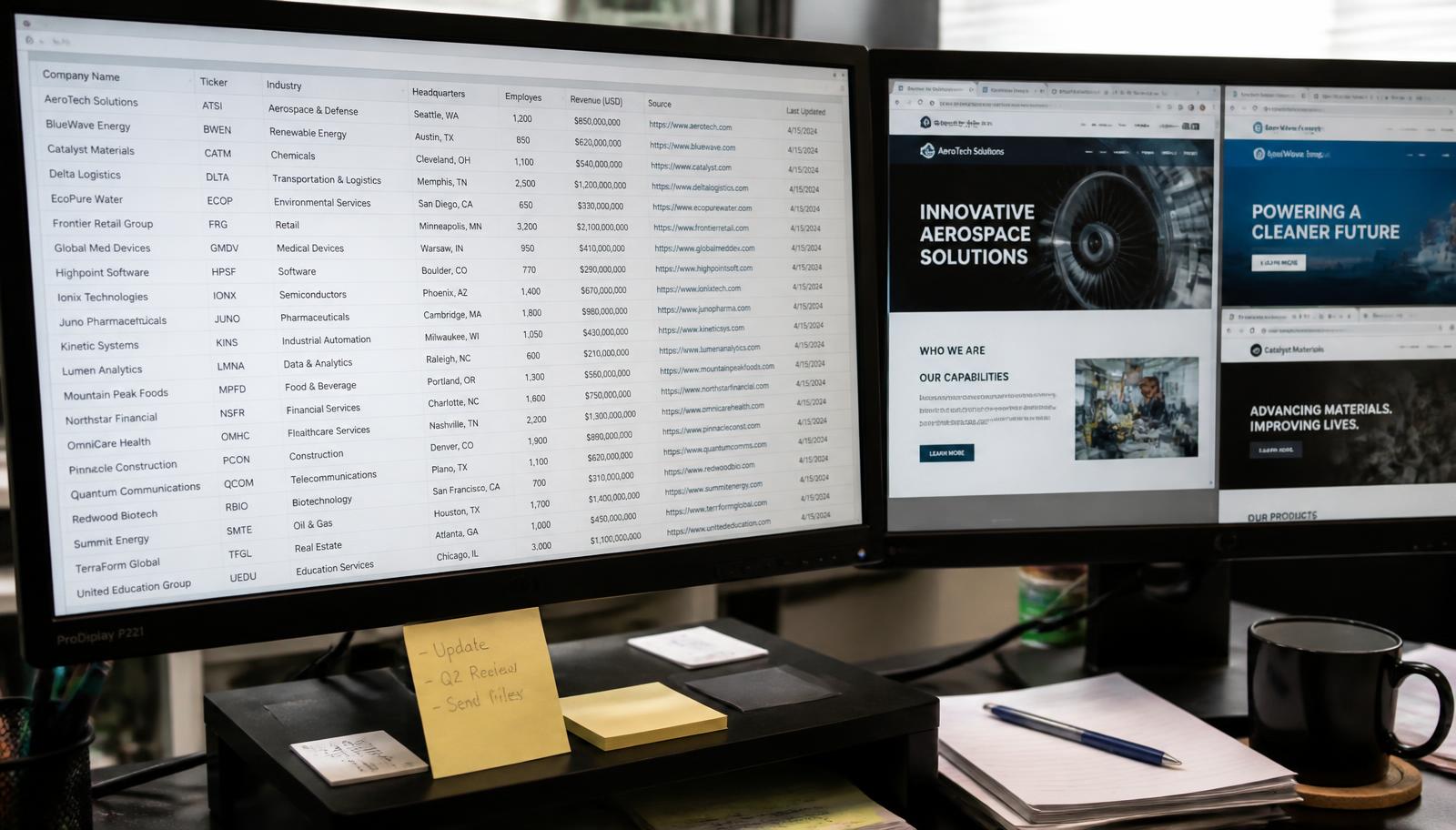
Enrichment workflow: source waterfall → match/resolve → validate/score → write-back → refresh; GDPR/CCPA-aware.
What good looks like.

Before anything runs, the team agrees which fields matter and which sources are trusted for each.

Each record is checked against live sources rather than a static, stale database.

A sample of enriched rows gets a human pass before the full batch is trusted.
What it must include
- 01Source records and target fields to enrich (firmographics, contacts, emails, tech stack, intent)
- 02data-source/API selection and waterfall logic (try source A → B → C)
- 03match/identity-resolution keys and dedup
- 04confidence scoring and validation (email verification, format checks)
- 05CRM write-back and field-mapping
- 06refresh/decay cadence (data goes stale)
- 07compliance (GDPR/CCPA, consent, suppression lists)
- 08cost-per-enrichment and coverage KPIs
Signals of expertise
- ★Builds a source-waterfall with confidence scoring and email verification
- ★handles identity resolution/dedup and data decay refresh
- ★addresses GDPR/CCPA consent and suppression
Common mistakes
- ×Single-source enrichment with no fallback or verification
- ×ignoring data decay and dedup
- ×no privacy/consent handling
- ×overwriting good CRM data

Frequently asked.
Is the AI Data Enrichment Workflow free to use?
Yes. You can generate a full an enrichment workflow for free with no signup and no credit card. An account is only needed if you want to save the result or download it later.
What do I need to provide to ai data enrichment workflow?
3 fields: Records, Fields, Sources. Each field has an example placeholder shown in the form, so you always have a model answer to work from even if you're not sure what to type.
How long does it take?
Most people get a finished an enrichment workflow in under five minutes: fill in the inputs, generate, then copy the result into ChatGPT, Claude, or Gemini. Most users reach an 80–90% ready result within 1–3 passes.
Which AI model does it work with?
The output is a portable prompt and template - it works with GPT, Claude, Gemini, or Perplexity. You paste it into whichever model you already use; nothing is locked to one vendor.
What makes a good an enrichment workflow?
It should include: Source records and target fields to enrich (firmographics, contacts, emails, tech stack, intent); data-source/API selection and waterfall logic (try source A → B → C); match/identity-resolution keys and dedup; confidence scoring and validation (email verification, format checks); and more. The tool is pre-loaded with these criteria so the generated draft already covers them.
You might also like.
AI Data Entry & Document Processing
Get processing workflow spec - just enter document types, fields, target systems.
AI Lead Qualification Agent
Get qualification agent spec - just enter lead sources, icp, routing rules.
AI Report Generation Agent
Get report agent spec - just enter data sources, format, cadence.